


A Diabetes Food Challenge: The California Burrito vs twiist™ AID & MiniMed™ (Medtronic) 780G Systems
Dr. Steve Edelman and Dr. Jeremy Pettus tackle one of San Diego’s most difficult meals while putting the latest hybrid closed-loop technology to the test. Who will stay in range and how?
In this Food Challenge:
- Head-to-Head Tech Battle: A real-world comparison between the MiniMed™ 780G and the new twiist™ AID system.
- Mastering the “Burrito Spike”: Specific dosing strategies for high-fat, high-carb meals containing carne asada, cheese, and french fries.
- The twiist™ Algorithm: How the Tidepool-based adaptive algorithm and targets as low as 87 mg/dl help maintain control.
- Advanced Features: Exploring twiist iiSure™ technology for occlusion detection and food-based bolusing for optimized absorption.
- MiniMed™ 780G Precision: Utilizing the Instinct sensor (made by Abbott) to provide the 780G with the continuous data needed for automated insulin delivery.
- The Rules of the Game: The doctors must stay within a 70-180 mg/dL range during the meal and for two hours after finishing the burrito.
Mastering Difficult Meals with Modern Automated Insulin Delivery (AID) Technology
We believe that everyone should be able to indulge in great food once in a while, even if you have diabetes! Instead of telling you what you can’t eat, our mission is to show you exactly how you can do it by leveraging the latest medical advancements.
There are currently five automated insulin delivery (AID) systems available for people with diabetes, and in this episode, we are putting two powerhouses head-to-head: the MiniMed™ (Medtronic) 780G and the twiist™. By testing these systems against a notoriously difficult California Burrito, we demonstrate how adaptive algorithms and customizable settings—like the twiist™ pre-meal target range and the MiniMed™ 780G’s auto-corrections every 5 minutes—can empower you to navigate even the most challenging menus with confidence.
Inside the California Burrito: Why This Meal is a "Blood Sugar Wrecker"
A California burrito is a large flour tortilla filled with carne asada, French fries, cheese, guacamole, salsa, and often sour cream, and it delivers a very high carbohydrate and fat load that can significantly raise blood sugar in people with diabetes.
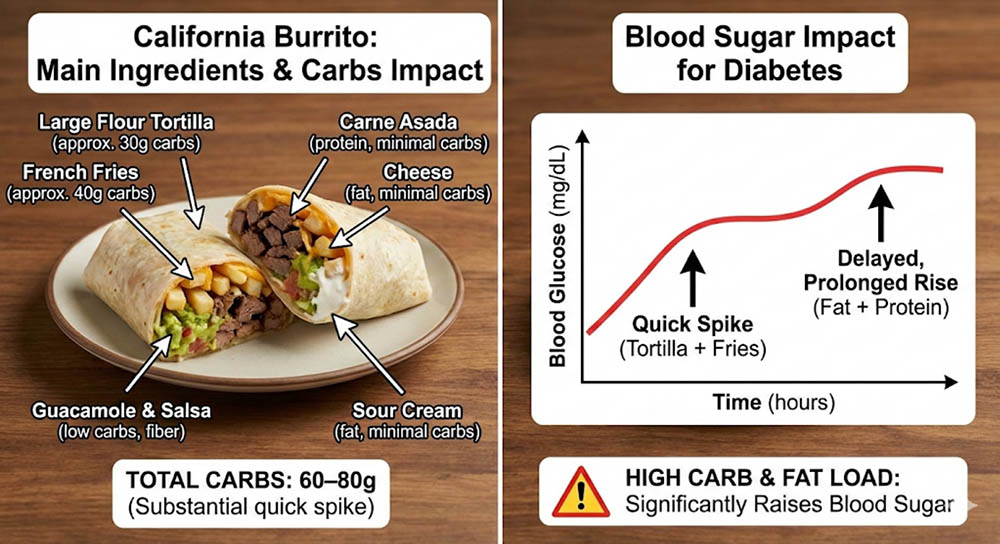
Main Ingredients and Carbs impact
Flour tortilla + fries
A large white-flour tortilla plus a serving of fries typically provides about 60–80 g of carbohydrates total, driving a substantial and fairly quick blood sugar spike for many people with diabetes.
Carne asada, cheese, sour cream, guacamole, salsa
Meat, cheese, and sour cream add protein and a lot of fat with minimal carbs, while guacamole and salsa are relatively low-carb. Together they slow digestion but can cause a delayed, prolonged rise on top of the initial spike from the tortilla and fries.
So how do Dr. Edelman and Dr. Pettus tackle this challenging meal? Find out now!

Loved it! Thank you for sharing your experience.
Glad you enjoyed it! 🌯
Have to try that burrito (or half) next time I’m in town!
Yes! They’re pretty amazing!
re: the delayed protein and fat impact on blood sugar, is that related to an insulin resistance factor?
No, it relates to how fast these nutrients get absorbed in the stomach.
Wow. I took a lot of notes from this. Thank you
Glad it helped! 🙂
I’m on MDI. For this meal I would calculate the carbs and split the dose in 1/3 or 1/4 and dose once an hour-1.5 hrs and monitor glucose closely
If it works for you, it sounds good to me!
Thank you both so much for this video. I can’t tell you how informative and validating it is. I’ve had T1D for 35yrs, gastroparesis for 13, using a Medtronic pump for 23 yrs, and on the 780g for 2 yrs. You have solidified for me that I need to find a new provider who is familiar with gastroparesis and different ways to manage my BG’s before, during and after meals, rather than just pre-blousing for all situations. I’m glad the way I am keeping my BG’s in range, isn’t “incorrect” as I am being told. Thank you again!
Thanks so much…appreciate it. Feel free to email Lynne at lynne@tcoyd.org with your city and state, and if we know of a provider in your area, we can send you a referral.
One trick I’ve used when low at meal time is to do an extended bolus, with 0 percent now, remainder over x number of hours, depending on meal. This avoids the problem of not blousing now, then forgetting to bolus later. Not a perfect solution, but good enough for now. Diagnosed sixty nine years ago, always eager for new tricks, new technology. Thanks for all you d.
Extended bolus is another way to go…thanks for sharing! And congrats on 69 years!! 👏👏👏