- Inhaled insulin Afrezza is now FDA-approved for children and adolescents aged 6 and older, so kids with either type 1 or type 2 diabetes can “call their own shots” on demand when it comes to mealtime insulin.
- Teens and adolescents have the most missed insulin doses out of any age group. Inhaled insulin offers a cool, easy-to-use option during school, sports, and social settings.
- Afrezza gets into your system fast and gets out of your system fast, helping to reduce post-meal spikes and delayed lows.
- Results from the INHALE-1 study showed comparable glucose control to traditional insulin injections, but with less weight gain and significantly higher treatment satisfaction among study participants and their parents.
Reading Time: 5 minutes
What if insulin didn’t have to mean another shot at school, during sports practice, or at social events? Now it doesn’t! The FDA just approved inhaled insulin Afrezza for children and adolescents aged 6 and older, giving young people a rapid-acting insulin option without the need for multiple daily injections or insulin pump therapy.
According to Dr. Edelman, this advancement is going to be life-changing for many families:
“I’ve been using Afrezza myself for 12 years, and I prescribe it to my patients all the time. Afrezza helps me with sticky highs and gives me the freedom to eat a donut (or two!) when I want to, and still stay in range. The Afrezza approval will allow kids to live a healthy, more normal life. Once people try it, they don’t want to go back.”
What Is Inhaled Insulin Afrezza?

Afrezza is a rapid-acting insulin powder that you inhale through a small, discreet device, almost like a whistle (without the screeching sound!).
Afrezza was approved for adults in 2014 and was the first non-injectable insulin in over 100 years. It also has a clean track record in terms of lung safety.
How Does Afrezza Work?
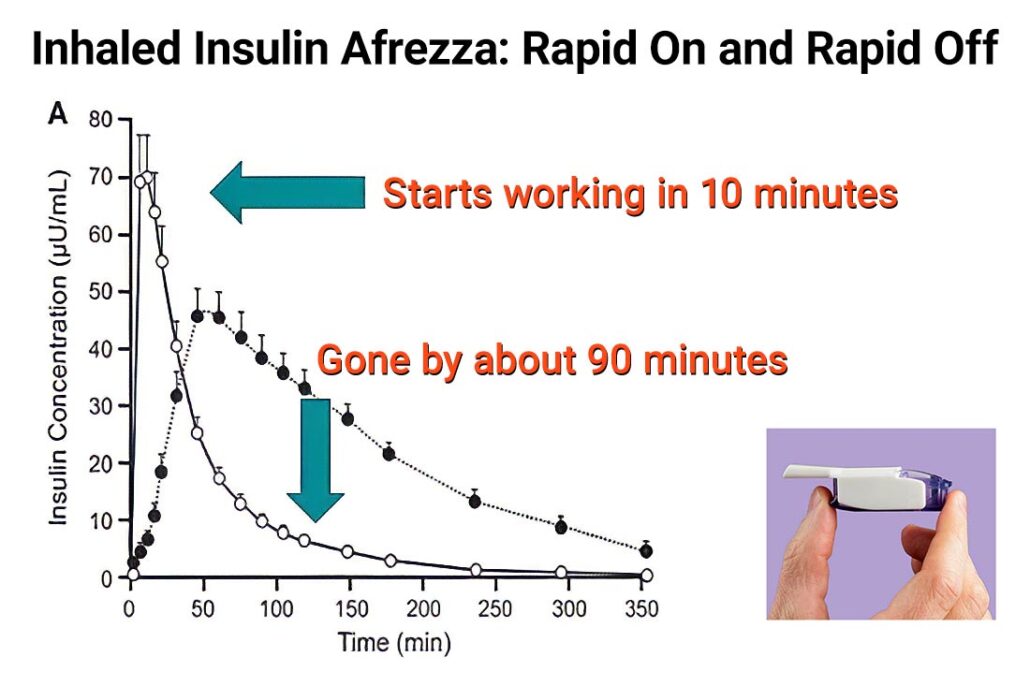
One of the biggest differences between Afrezza and traditional rapid-acting injected insulin is how fast it works.
Afrezza enters the bloodstream through your lungs, which allows it to start working in about 12 minutes. It reaches peak effect in around 45 minutes, and is out of your system in 1.5 to 3 hours. This shorter duration means insulin spends less time in your system, so there’s less risk for delayed hypoglycemia.
Drs. E&P demonstrate how to use Afrezza in this video:
Inhaled vs. Injected Insulin in Kids: What the Research Says
The Afrezza FDA approval for kids and teens was based on results from the INHALE-1 study, which evaluated whether inhaled insulin could safely and effectively replace injected insulin at mealtimes for this age group.
Half of the 230 participants in the 26-week study used Afrezza at mealtimes and for corrections, while the other half used injected rapid-acting insulin. Both groups used their long-acting injected basal insulin.
Overall, the study found that inhaled insulin is a safe and effective alternative for mealtime insulin, offering comparable blood sugar control with the added benefit of being needle-free, and no need to time the injection 20 to 30 minutes before eating. Afrezza can be taken right at the start of a meal.
- Participants using Afrezza achieved similar blood sugar control as those using injected insulin.
- Rates of hypoglycemia were similar between groups, with a trend toward less delayed post-meal hypoglycemia in the Afrezza group.
- Afrezza provided better early post-meal glucose control, likely due to its rapid onset.
- Participants using traditional injected insulin experienced greater weight gain compared to the Afrezza group.
- The group using inhaled insulin reported statistically significant greater satisfaction with their treatment.
What the Afrezza FDA Approval Means: Benefits Beyond Blood Sugar

For teenagers especially, diabetes doesn’t happen in a vacuum. It happens at school, at after-school activities, at sleepovers, and in front of friends. And anything that makes a kid feel like they’re different from the crowd can turn into something they avoid. So when insulin is easier to use, kids are more likely to use it.
Key Benefits of Afrezza for Kids & Teens:
Needle-Free:
Afrezza offers an alternative insulin option for kids who are needle-averse or experiencing injection fatigue. Kids on MDI often hate to take pre-meal shots, as well as correction and pre-snack injections. And there’s no need for needle disposal.
More Discreet:
The Afrezza inhaler is compact and easy to use in social settings without drawing as much attention as an injection or an insulin pump.
Fast In, Fast Out:
Afrezza’s rapid onset and shorter duration can help improve post-meal blood sugars, reduce insulin “stacking,” and lower the risk of delayed hypoglycemia.
No Injection Site Rotation:
You don’t have to worry about continuously finding new injection sites on the body.
Fits Active Lifestyles:
Afrezza can be easier to use around sports and other activities since there are no devices attached to the body, and there’s less concern about timing insulin perfectly around exercise.
Less Weight Gain:
In studies, Afrezza was associated with less weight gain than injected insulin.
During the teenage years especially when missed insulin doses and treatment fatigue are common, inhaled insulin can make diabetes management much more adaptable for real life.
Safety and Side Effects
Afrezza is inhaled through the lungs, so researchers carefully monitored the lung health of all participants during the study. Lung function remained similar in both groups, and no serious lung-related complications were reported. The most common side effect of Afrezza was a mild cough after inhalation.
As with most medications, there are some people who should not use Afrezza, including those who smoke and anyone with long-term chronic lung conditions such as those who have active asthma or COPD. Your child’s doctor should order a baseline test to check lung function before starting treatment.
Real-World Insights: Q&A with INHALE-1 Study Participants
We spoke with INHALE-1 study participant Phillip and his parents, Jim and Andrea, to hear firsthand how inhaled insulin compared with injections for a teen living with type 1 diabetes, and what the experience was like from a parent’s point of view.
Why were you interested in participating in the INHALE-1 study?
Andrea: At that time, Phillip had been diagnosed for a few months. We took a deep dive into Type 1 Facebook groups. The Afrezza trial ad popped up. Noticeably, watching him pre-bolus before every meal, then having to wait to eat became frustrating for him. As a parent, it’s hard to see that, let alone also being frustrated.
Phillip: I thought it’d be a lot more convenient to use inhaled insulin instead of shots. With shots you need to worry about timing, rotating sites, carrying around needles, alcohol pads, and a sharps container. Inhaled seemed (and was) a lot simpler to use.
What were your biggest concerns (if any) going into the INHALE-1 study?
Andrea: Honestly, one concern was the study of what taking Afrezza could do to your lungs, long term.
What was it like using inhaled insulin day-to-day?
Andrea: At the risk of people thinking he was vaping, I think it was a kind of relief for Phillip.
Jim: It was obvious he preferred the speed with which he could use the inhaler, and the much quicker response of his blood sugar, compared to doing individual injections.
Phillip: Inhaled insulin allowed me to be much more spontaneous with my eating and activity. I don’t really have to plan what or when I eat because the inhaled insulin works so fast. It’s also useful for activity and corrective doses since the insulin starts working and exits my system very quickly so I can react to blood sugar changes much faster than with shots.
Did using inhaled insulin change how you approached meals/ food choices?
Andrea: I think it was detailed carb counting. I packed his lunch and counted every carb (minus the fiber). I texted Phillip the total count so he could prebolus in class before lunch. With Afrezza being able to hit his bloodstream a lot faster, there wasn’t and isn’t such a time issue. Of course, he may have to correct afterwards. His lunches were pretty much the same every day at school, so he would know the amount of Afrezza to use.
Phillip: It gave me a lot more freedom as to what and when I eat. Shots require prebolusing, so you need to preplan when you eat and are locked in to a certain meal/carb amount once you administer the shot. I take Afrezza right after my meals so I can eat what I want when I want, and all I have to keep track of is the carb count.
Did you notice any differences in blood sugar patterns compared to injected insulin?
Phillip: Correction doses start working much faster than with shots, which I like because I think it gives me more control. My strategy is to be a little heavy-handed with my corrections and bring my blood sugar back up if needed. Though this has caused me to go low more than I did with shots. The one difficulty I’ve had is when my metabolism is slow the speed that Afrezza starts working can make it so I have to be very aware of my digestion. There have been times where I’ll eat something, take Afrezza immediately, then go low and spike up hours later because the food wasn’t digested yet.
Were there any changes in quality of life?
Andrea: Perhaps there was a relief for Phillip only having to inject Lantus daily rather than his Humalog before every meal. Phillip is a martial arts instructor and is a second-degree black belt. He was working towards his first-degree black belt when he was diagnosed. Other than his CGM, he did not want another item attached to him that could get in the way of being physical.
Can you describe a scenario when Afrezza addressed a pain point or challenge?
Jim: As above, due to martial arts, he would not consider a pump, and the Afrezza was much easier for him to use and manage his blood sugar, which had more variation due to the impact of the various workouts as far as the intensity and duration, which was different, if not day-to-day, then week-to-week. With his own training and teaching martial arts, he often would be doing rigorous physical activity for 3-4 hours, mostly multiple times a week on weekday evenings, but also with some additional weekend mornings.
Phillip: I always found the process of administering shots annoying. There are so many different things you need to have with you, it hurts, it takes a long time, you need to rotate sites, and you might have to do multiple shots if you’re eating a lot. Afrezza completely removed the inconvenience barrier with taking insulin. It’s so easy you don’t really even have to think about it.
Were there any side effects or challenges using inhaled insulin?
Phillip: I didn’t experience any side effects or have challenges using the medication.
Would you prefer to keep using inhaled insulin or go back to mealtime injections, and why?
Phillip: Inhaled insulin is easier to use and its fast action lets me manage my blood sugar in almost real time. I’ve also found that inhaled insulin is just as space efficient as shots to carry on my person when you factor in needles, pads, etc. For me, inhaled insulin has made every meaningful part of managing my diabetes easier. I have no reason to switch back. It also helps that using an inhaler doesn’t hurt.
What would you say to another parent/child who’s curious but nervous about inhaled insulin?
Andrea: What I had learned, from being a parent of a teenager and reading about how other teens dealt with being diagnosed, is that it’s good to let your older child decide how they would like to manage taking care of their blood sugars.
Jim: It is easier and faster (both to take out and use, and for the effect on blood sugar). It also does not require the exposure of thigh or abdomen etc to inject in public if that is a concern for the child.
Phillip: I’ve never used a pump so I can’t make a comparison there, but I genuinely cannot think of a single aspect of managing diabetes that is easier or more convenient with shots than inhaled. My life with Afrezza is much closer to my life pre-diabetes than I ever got with shots, and I’d be willing to bet you’ll feel the same way if you switch.
Anything else you’d like to share?
Andrea: Neither of us have any stock or other vested interest in MannKind, the makers of Afrezza. Be prepared to relinquish a full shelf in your refrigerator for the medication – depending on how many boxes you receive at a time!
Phillip: You can use the cartridges as a fidget toy.
Afrezza Pediatric Approval for Kids Aged 6 and Older: Key Takeaways
The FDA’s expanded approval of Afrezza will make a huge difference in the day-to-day management for kids living with diabetes.
Afrezza offers more flexibility around unpredictable meals and schedules, and its rapid onset and shorter duration mean less insulin “hanging around” during sports and other activities. It also makes taking insulin less disruptive, which can boost confidence in kids and ease worry for parents.
Units of inhaled insulin are not equal to units of injectable insulin, so work with your doctor to determine which dose is right for you. And if you’re not using a CGM, get one! CGMs make tracking your blood sugar and the effects of Afrezza easier.
At the end of the day, expanding access to options like inhaled insulin isn’t only about better blood sugar, it’s about helping diabetes fit better into everyday life.
Afrezza is already available for adults in the U.S., Brazil, and India. Speak with your healthcare provider if you are interested in Afezza for you or your child.
Explore our resource library and video vault, and subscribe to our monthly digital newsletter for more tips, tools, and expert guidance on how to take control of your diabetes.
This article was supported by an unrestricted educational grant from MannKind.

Our goal is to protect your personal health information. Please keep your questions general and do not post personal medical information here. If you have a specific question, please email events@tcoyd.org.