


What Is Latent Autoimmune Diabetes in Adults (LADA)?
LADA stands for Latent Autoimmune Diabetes in Adults. In non-medical speak, all it means is type 1 diabetes that’s diagnosed in adulthood.
The term LADA was created because the condition presents a little differently than “classic” type 1 diabetes. Some people call it LADA diabetes or LADA type 1.5, but it’s not a different type – it’s part of the type 1 diabetes spectrum.
How Is LADA Different from Classic Type 1 Diabetes?
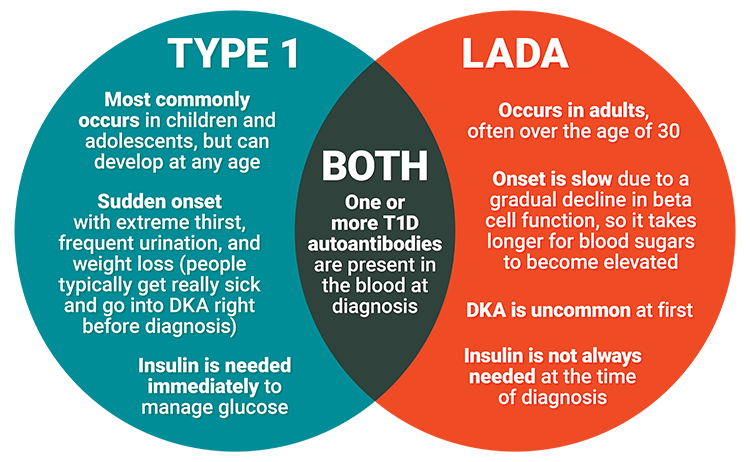
The primary differences between LADA and classic type 1 diabetes are related to the speed and timing of onset. Classic type 1 typically happens in childhood or adolescence and comes on fast, with symptoms that escalate quickly and require insulin right away. Many people get super sick and are diagnosed after being hospitalized for diabetic ketoacidosis (DKA), which is a serious and dangerous condition if left untreated.
LADA, on the other hand, shows up in adulthood and develops slowly. People with LADA can still produce some insulin for a while, and their symptoms may not be as extreme.
Key Characteristics of Classic Type 1:
- Most commonly occurs in children and adolescents, but can develop at any age
- Sudden onset with extreme thirst, frequent urination, and weight loss (people typically get really sick and go into DKA right before diagnosis)
- Insulin is needed immediately to manage glucose
- One or more T1D autoantibodies are present in the blood at diagnosis
Key Characteristics of LADA:
- Occurs in adults, often over the age of 30
- Onset is slow due to a gradual decline in beta cell function, so it takes longer for blood sugars to become elevated
- DKA is uncommon at first
- Insulin is not always needed at the time of diagnosis
- One or more T1D autoantibodies are present in the blood at diagnosis
Anyone at any age can be diagnosed with new onset “crash and burn” classic type 1 diabetes. Not all new adult-onset cases are LADA.
Why LADA Gets Misdiagnosed…a LOT!
There are three main reasons why LADA is the most frequently missed diagnosis in diabetes:
First, there’s a long-held belief that type 1 diabetes is a childhood disease. For decades, T1D was labeled “juvenile diabetes”, but the reality is that more adults are diagnosed with type 1 diabetes than children every year.
Second, LADA doesn’t follow the typical patterns doctors are trained to expect for type 1 diabetes. It shows up in adulthood, it progresses slowly, and it doesn’t always require insulin right away.
Third, most adults typically see primary care providers who may be less familiar with LADA, so they assume someone has type 2 diabetes simply due to age and the slow onset of the condition. And you know what they say about making assumptions! 😉
Type 2 diabetes is associated with a distinct set of features that are not commonly seen in LADA, including:
- A genetic predisposition and/or family history of type 2 diabetes
- Excess weight, especially around the midsection
- Signs of metabolic syndrome, such as high triglycerides, low HDL, high LDL, and high blood pressure
- The ability to improve blood sugar management through lifestyle modifications like diet and exercise
So, How Is LADA Diagnosed?
If type 1 diabetes is suspected (and it might have to be you pushing for this!), your HCP can order blood tests that look for the following type 1 diabetes autoantibodies:
- Insulin autoantibody (IAA)
- Glutamic Acid Decarboxylase Autoantibodies (GADA or Anti-GAD)
- Insulinoma-associated antigen 2 autoantibody (IA-2A)
- Zinc transporter 8 autoantibody (ZnT8Ab)
If you can only get one test, the most important one to get is the GAD, which signals that your immune system is attacking the insulin-producing beta cells in the pancreas.
Another important indicator is the C-peptide test, which measures how much insulin your body is still making. People with LADA typically still produce some insulin at diagnosis, but levels drop off over time.
It’s possible for someone with type 1 diabetes to test negative for autoantibodies. Obviously this makes their LADA diagnosis more complicated, but it does happen in about 15% of cases.
Who Is Most at Risk for Developing LADA?

People with other autoimmune conditions such as celiac disease, or thyroid disorders like hyperthyroidism (Graves’ disease) and hypothyroidism (Hashimoto’s thyroiditis), are also at increased risk.
Screening for type 1 diabetes is fairly straightforward – a blood test at your doctor’s office can detect the markers that indicate whether type 1 diabetes is developing.
The Silver Lining of LADA…There Really Is One!
Since beta cell function declines gradually with LADA, many people have a “honeymoon phase” when their body is still producing some insulin.
This extra runway of time can help in several ways:
- It gives you some breathing room to learn about diabetes without needing full insulin therapy right away
- Even small amounts of your own insulin can help decrease glucose variability (the ups and downs of blood sugar levels)
- It allows you to be a little less precise with insulin dosing and counting carbs
- It can make the transition to insulin feel less abrupt and overwhelming
- It provides an opportunity to explore the latest technologies and treatment options
- It provides an opportunity to explore clinical trials in the space
Being diagnosed as an adult can translate to fewer years with elevated blood sugar levels and fewer years with glycemic variability, potentially reducing the risk of acute and chronic complications.

Our goal is to protect your personal health information. Please keep your questions general and do not post personal medical information here. If you have a specific question, please email events@tcoyd.org.
Great article. Most people do not know any of this information. I was misdiagnosed in 1997 Ac1 over 18. and it was 5 years before the C peptide test was available and I finally correctly diagnosed.
Wow, that’s a looooong time to go with the wrong diagnosis. Sadly, it’s still happening 30 years later and with testing available.
Excellent, informative article that could have been written about my journey with diabetes. I was diagnosed with T2D in 1997, at the age of 38. I remember being told “You’re too fit to be a Type 2 but too old to be a Type 1.” It was so frustrating to be told again and again that I was failing treatment, bouncing around so many drugs and finally bedtime insulin – and still never getting any real control. A severe episode of DKA (near fatal) finally led to a Type 1 diagnosis. It is great that so much more is understood about LADA, but unfortunate that so many people are still being misdiagnosed.
So well said…agreed!
Misdiagnosed at 42 as T2. Zero family history, not overweight, came on quickly. But I did have hypothyroidism. Pills, intense physical training, and full nutrtional ketosis kept the insulin away for 5 years. Then I got hurt and my BGs shot up. Went to an endo who looked at my data and said I was not T2. GAD test showed it. I am now 60. Have not had an A1C higher than 6.4 since going on insulin.
Getting hurt was a blessing in disguise for sure…and congrats on the awesome A1c! 👏
This article is exactly my story. I have a family history of T1 diabetes but when I was first diagnosed by my family physician at age 54, I went through the same frustrating progression as outlined above of progressive medications. Even though I was doing everything I could to manage my diabetes my A1C would continue to go up . After 12 very frustrating years, I made an appointment with an Endocrinologist. His first words to me were “You don’t fit the profile of a T2 diabetic”. I was baffled by what he said! He ordered the blood tests which confirmed I was a T1 diabetic. I went off all the other medications, started on insulin and have not had an A1C above 6.5 in 2 1/2 years!! I still work very diligently to manage my diabetes but now I see the benefits. I share my story all the time to others in hope that they or others they know avoid what I went through. I also share your website with everyone I can as I have found it to be extremely helpful in educating myself about diabetes and how to manage it.
Thank you so much for sharing your story…12 years with the wrong diagnosis is one of the longest we’ve heard yet. Glad you finally found an endo who helped you get the right diagnosis. Thank you as well for your kind words about our website and congrats on the amazing A1c!!
Please mention that type 1/LADA can also appear following gestational diabetes! I was first diagnosed with gestational diabetes, and had to take insulin while pregnant since diet/exercise did nothing to help me (I was already thin and exercising a lot). After the pregnancy I stopped taking insulin but 6 weeks later failed the follow up glucose test. At first the doc thought I had pre-type 2 (despite me having no risk factors for that), and he said if I lost my pregnancy weight it might recover. I lost the weight and my blood glucose levels went up. So he finally tested me for antibodies, they were positive (GAD), and I went back on insulin. Luckily the honeymoon period lasted a long time (years). But eventually my c-peptide indeed went down to nothing. That was 27 years ago– I have encountered quite a few women in diabetes groups who had my same experience of gestational diabetes leading to type 1 (I did have a glucose test before pregnancy and it was perfect). There are scientific studies written about it (e.g., https://www.jstage.jst.go.jp/article/tjem/259/4/259_2023.J013/_article). I wish more doctors knew about this!
You are so right…developing type 1 diabetes after gestational diabetes is not as common as developing type 2, but it does happen. Thanks so much for sharing your story!
I was diagnosed T2 at age 62. Because everyone on my dad’s side of the family had died from diabetes complications, I immediately changed my lifestyle, switching to a strict a diabetic plate diet and starting to exercise. Lifestyle changes worked! WOW! My A1c stayed under 7 for almost 3 years and I lost 40+ pounds! Then, with no warning, my A1c was 12.8! HORRORS! My PCP said that all of my weight loss was catabolism, and shamed me for not taking my diabetes seriously. My endo, whom I had been seeing for 20+ years for Hashimoto’s disease, put me on Tresiba, Farxiga, and Ozempic, gave me a CGM, and then retired. My new endo kept me on Tresiba, Farxiga, a low carb diet, and a CGM, and my A1c stayed under 7. But there was a major complication. My PCP believed that T2 patients should not be on insulin and made every office visit a horrible experience for me because my new endo wanted me to continue using Tresiba. Then, that endo left the practice, and I was handed over to a third endo. About that time I was referred to a hemotologist. She diagnosed me with ITP and very emphatically told me that my diabetes was also autoimmune. Huh? Well, that did explain some things. So, I asked my current endo for testing for Type 1. Oh, no, he said, you definitely do not have Type 1 diabetes. Your numbers are too good for Type 1. (My numbers were really good because I ate to a low carb diet, exercised, used Tresiba and Farxiga, and my life was ruled by my CGM.) But to humor me, he agreed to order antibody tests. I was positive for 3 out of 4 of them. So last year, at age 68, my endo changed my diagnosis to Type 1, explained the dangers of taking Farxiga with Type 1 diabetes, and (YES!) switched me to a very good, much nicer, PCP. After 7 years now, at age 69, I think I am about done honeymooning, so this month I quit taking Farxiga, and started mealtime insulin. Yes, with such a long honeymoon, it was difficult to correctly diagnose my T1 diabetes!
Wow, that is quite a story! It is so unfortunate that so many doctors are either not knowledgeable or not open to looking deeper into issues regarding diabetes and type 1 in adults. Good for you for advocating for yourself, and so glad you finally got the right diagnosis!!
Great pos! Misdiagnosed at 35 in 2023. I’ve always been very active, with a reasonably healthy vegetarian diet. Dropped a few pounds and was feeling super healthy at annual physical. Blood work a week later showed fasting glucose of 275. A week later retested and a1c was 12.3. Bought a finger prick kit and was at 560 4 hrs of lunch.. the next morning pcp told that was all classic Type2 and started me on metformin; also told me to just test once a day. Got very sick over the next few weeks with fasting glucose steadily in the 300s while barely being able to eat anything, lost abt 25 lbs in 4-6 weeks.Luckily found the TCOYD podcast abt lada, read a lot, got trial net testing and was doing overwhelmingly positive for all 4 antibodies. Still couldn’t convince my doctors (both pcp and the endo he referred me to)to agree it was not type 2 because my cpeptide was over 0.8 – refused cgm n insulin.. found a new endo with a lot of research in T1D to get the right treatment..had sort of a honeymoon with low insulin needs., 3 years later, c peptide is still arnd 0.7, but fully insulin dependent T1
That’s so crazy….so glad you found us and got a new endo who knows what’s up!! Thanks for sharing your story!
Your subscrbe button is not present on the main page. It only shows the code but there is not button to subscribe
Thank you! We are working on getting it fixed!
Just diagnosed as LADA and prescribed one morning dose of Lantus after 5 years of being told I had T2, controlled with Metformin and Jardiance.
The subscribe button is missing but I’d like to sign up for your newsletter.