
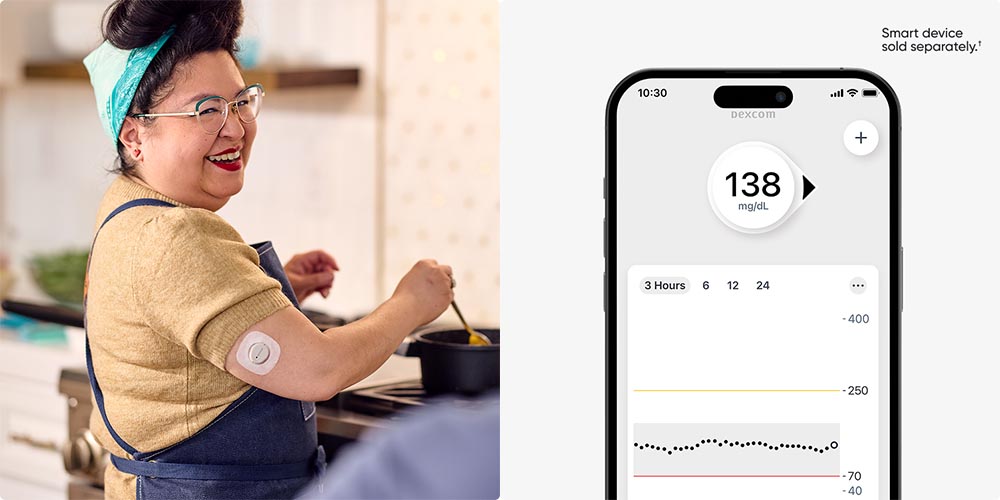
- Whether you are newly diagnosed or have lived with type 2 diabetes for decades, a CGM can provide helpful information at any stage of the condition.
- CGMs help you learn how things like food, exercise, illness, stress, and certain medications can affect your glucose levels.
- People with type 2 diabetes can see improvements in A1c and time in range with a CGM, even if they aren’t taking insulin.
- Access to CGMs for people with type 2 diabetes worldwide is improving, but there are still challenges to overcome regarding education, insurance coverage, and affordability.
Reading Time: 4 minutes
Did you know there’s a tiny little device smaller than a Ritz cracker that’s one of the most powerful tools for managing type 2 diabetes? (You can’t put Cheez Whiz on it, but it can tell you what Cheez Whiz does to your glucose levels!)
For years, continuous glucose monitors (CGMs) were thought of as a tool primarily for people with type 1 diabetes, but thankfully that’s changing.
New data from Dexcom’s State of Type 2 Report: Global Access and Attitudes to Diabetes Technology showed that adults with type 2 diabetes who use a CGM reported “consistently exceptional” outcomes. Consistently exceptional!
Additionally, results from a study called CONNECT showed that people with type 2 diabetes using Dexcom CGM had greater improvements in A1c and time in range (the percentage of time spent with glucose levels between 70-180mg/dL) compared to those not using a CGM.
How can one small device pack such a big punch? Here’s what makes a CGM pivotal at any stage of the condition.
1. A CGM for Prediabetes? Yes, It Can Help
Getting the news that you have prediabetes can be a shock, but it can also be an opportunity to start making small lifestyle changes that can help improve your health. This is where a CGM can have a big impact.
When you use a fingerstick to check your blood sugar, you only see your glucose for one fleeting moment in time. With a CGM, you can see your glucose levels every 5 minutes, 24/7.
This helps you learn how your glucose levels respond to things like food, exercise, stress, sleep, illness, etc. A CGM shows you which foods spike your levels and which foods have a more modest effect. Maybe you find out that rice sends your glucose levels through the roof, but a walk after eating helps bring them back down.
Prediabetes doesn’t have to be a waiting room on the way to type 2 diabetes. The earlier you learn about what affects your blood sugar, the more opportunity you have to make changes that can potentially keep prediabetes from progressing to type 2.
2. It Can Help Improve Your A1c
Dexcom conducted a study in 2026 called CONNECT to determine if CGMs could be beneficial for people with type 2 diabetes not on insulin.
The data revealed that using the Dexcom G7 CGM significantly improved A1c, glucose control, and time in range, even for people on diabetes medications like metformin, GLP-1s, and SGLT2s.
Here are a few key points of the study:
- Study participants using Dexcom G7 experienced, on average, a 1.6% A1c reduction at 26 weeks, representing a 0.9% greater A1c reduction compared to the control group.
- Dexcom G7 provided additional A1c improvement even for people already taking medications such as SGLT2s and GLP-1s.
- Time in the glucose target range of 70 to 180 mg/dL was five hours per day greater for those using Dexcom G7 compared to the control group.
These results show that a CGM is more than just a way to check your glucose levels; it can actually be a tool to help you improve them.
3. It Can Tell You If Your Medications Are Working
Type 2 diabetes is a progressive condition, which means that over time, your pancreas may start making less insulin, and your body may become less responsive to the insulin you do make. As a result, blood sugar can become harder to control, even if you’re doing everything “right.”
There may come a time when you need a new medication added to your regimen, or you may need a higher dose of the medication you’re on just to keep your blood sugar in your target range.
With a CGM for type 2 diabetes, you’ll be the first to know if your glucose levels start changing. You won’t have to wait months until your next doctor’s visit and A1c test to see if your diabetes medications are working the way they should.
4. It Can Help You Find the Right Dose of Insulin
It’s not unusual for people with type 2 diabetes to need insulin at some point. This doesn’t mean you’ve transitioned to type 1 diabetes, or that you’ve failed in any way – it just means your diabetes has changed.
Most people will start out on one shot of long-acting insulin (also called basal insulin) per day. A CGM can give you a very clear picture of how the basal insulin is working. If your levels are consistently rising overnight, your basal insulin dose might need to be increased. If your levels are consistently dropping overnight, your basal insulin may be too high.
If you use short-acting (mealtime) insulin, a CGM can help you figure out how much insulin you need when you eat. It can also help protect you from hypoglycemia by notifying you if your levels start to dip too low.
5. It Plays Well with GLP-1 Medications Like Ozempic and Mounjaro
GLP-1 medications are more popular than ever, with no signs of slowing down. According to Dexcom’s State of Type 2 Report, GLP-1 use in many parts of the world has nearly doubled since 2024, and CGMs are emerging as a natural complement to these medications.
Most people find that their appetite decreases and their blood sugar control improves when they start taking these medications, so a CGM can help spot changes in glucose patterns that may warrant a medication adjustment from your healthcare team.
6. It Can Improve Your Time in Range & Lower Complication Risk
Time in range is the percentage of time your blood sugar stays between 70 and 180 mg/dL. Research has linked greater time in range with a lower risk of diabetes-related complications. For most people with diabetes, the goal is to spend at least 70% of the day in this range, which is about 17 hours a day.
CGMs give you immediate feedback on how food, activity, and other daily habits affect your levels, making it easier for you (and your healthcare team) to recognize patterns and make changes that can help keep you in range more often.
7. It Can Help You Stay on Track Between Doctor’s Visits
Your diabetes doesn’t take a six-month vacation between doctor’s appointments, and neither does your blood sugar. A CGM gives you ongoing feedback so you can see what’s working and where you may need a little extra help.
In Dexcom’s report, more than half of CGM users said they followed their treatment plan more closely after starting CGM. Even more impressive, 94% said CGM helped them manage their diabetes more independently, and 91% said they used the information to help make treatment decisions.
Instead of waiting for your next A1c to deliver the news, a CGM helps you make sense of your glucose levels while life is actually happening.
So Why Doesn’t Everyone with Type 2 Diabetes Have a CGM?
Now that we know all these important benefits of CGM for type 2 diabetes, why doesn’t everyone have one?
There are three main hurdles to overcome: awareness, access, and affordability.
According to Dexcom’s report, 55% of people with type 2 diabetes have little knowledge of CGMs, and insurance coverage limitations are a major barrier to access.
Healthcare providers play a crucial role in patient education, so equipping them with the right tools and knowledge can enable them to have more impactful conversations with their patients.
Progress is being made toward more access and affordability, but change doesn’t happen overnight.
In the U.S., Dexcom has coverage for all people with diabetes across the four largest commercial pharmacy benefit managers (PBMs). This provides reimbursement for more than 7 million people with type 2 diabetes who are not on insulin, while still anticipating Medicare coverage for this cohort by mid-2027. However, there’s still a long way to go to get CGMs in the hands of everyone who could benefit.
CGM for Type 2 Diabetes: Frequently Asked Questions
🤝 Does insurance cover CGM for type 2 diabetes?
If you have type 2 diabetes, most insurance plans cover a CGM if you are on at least one shot of insulin per day. Typically, this means one shot of basal (long-acting) insulin.
💰 How can I get a CGM if my insurance won’t cover it?
If your insurance does not cover CGM, and you have type 2 diabetes and do not use insulin, you can purchase one over the counter at Stelo.com, or you can ask your doctor’s office if they have free samples. You may not need to wear a CGM 24/7 to still get the benefits of the information it provides – wearing one for even a short period can provide important insights.
If your doctor tells you that you could benefit from starting on insulin, don’t think of it as a failure! Insulin can be an extremely effective tool, and the minute you’re prescribed insulin, you become eligible for a CGM through most insurance plans.
💚 Is Dexcom CGM for type 2 diabetes?
The Dexcom G7 CGM is for anyone with type 1 or type 2 diabetes. The Stelo glucose biosensor is for people with prediabetes or type 2 diabetes who are not on insulin and can be purchased over-the-counter without a prescription.
The Benefits of CGM for Type 2 Diabetes: Key Takeaways
CGMs are more than just a way to check your glucose levels; they’re an educational tool that can help you better understand and manage diabetes at any stage.
Research has shown that people with type 2 diabetes who use a CGM can see significant improvements in A1c and time in range compared with those using fingersticks. The benefits have been seen even in people who aren’t taking insulin, including those using medications such as GLP-1s and SGLT2 inhibitors.
The technology is available, and the evidence is here. Now we need to make sure that everyone who could benefit from a CGM knows about it, is educated about it, and can access it.
This article was supported by an unrestricted educational grant from Dexcom.
Explore our resource library and video vault, and subscribe to our monthly digital newsletter for more tips, tools, and expert guidance on how to take control of your diabetes.

Our goal is to protect your personal health information. Please keep your questions general and do not post personal medical information here. If you have a specific question, please email events@tcoyd.org.
Tell this to Medicare. You dont have to be a tub of lard to have tyoe 2 diabetes
You nailed it!
The veteran’s administration will only provide if on insulin m. Bue will give yoi glp1 and 2 ot metformin for pre diabetes
We need help from these insurance companies to help us with the monitor because it’s hard to keep up what you can eat what you can’t eat and keep your diabetes under control. They’ll help pay for that Mojarro and Ozempic, but they won’t help you pay for the sensor I think the sensor is very important because if you get too high or too low and you live alone, you could die so the sensor wakes you up when your sugar drops too low or when it’s too high, so please help us get sensors OK through insurance companies and Medicare part B.
We agree that CGMs should be covered by insurance for everyone with diabetes. Many diabetes organizations and advocacy groups are working hard to make this a reality and progress is being made, but we feel your frustration!